Killenummery - Cill An Iomaire
In Irish, Cill an Iomaire means “the church of the ridge.” As the most northerly part of the diocese and separated from the rest by what Bishop MacNamee quaintly called “three radio miles,” it is often thought of as our island parish. Straddling counties Leitrim and Sligo and bordering Lough Gill, the area naturally evokes images of Bee-Loud-Glade-like shoreline and the soft lap of lake water.
Several explanations have been offered for its inclusion in the Diocese of Ardagh. These range from historic Conmaicne connections to the possibility that diocesan boundaries, drawn after the Synod of Kells in 1152, were influenced by Bishop Magrath O’Moran—who may have been linked to the local erenagh family. Another suggestion points to the displacement of the Calraighe by the Conmaicne from ancient Longford in times long past.
Local tradition also recalls Aodh Béo, who passed through Tullynascreena—now the site of the mass rock—on his route from Ard-Carn through Inis Mac Grath to Ballintogher. During the Penal era, Mass was celebrated using that flat-topped rock as an altar. To mark the parish Millennium, Mass was celebrated there again; in preparation, people processed to the rock, and a group reenacted the Penal-era practice by coming up the stream in period costume.
Killenummery, in the barony of Dromahair, comprises 23,183 statute acres and had a population of 1,240. Christian origins here may even trace back to St. Patrick, though more certainly to St. Hugh, who ministered by unusual routes to avoid detection by the Redcoats. The old Church of Ireland still stands, and nearby are the remains of a 14th-century nunnery that was later used as a hospital.
Tullynascreena Mass Rock
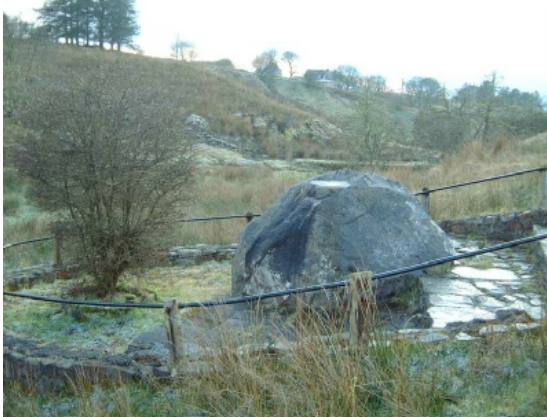
Hidden in the hills overlooking Dromahair, the Tullynascreena Mass Rock is one of the most important Penal‑era landmarks in the parish of Killenummery & Killery. Set high on a ridge at around 170 metres above sea level, the rock served as a secret gathering place for local Catholics during the 17th and 18th centuries, when public worship was forbidden and priests risked arrest or execution for celebrating Mass.
From this elevated position, families from the surrounding townlands could keep watch for approaching patrols while the priest celebrated the sacraments on the flat surface of the rock. Tradition links the site with Fr. McGovern O.F.M., a Franciscan priest who ministered in the area during Penal times and is buried at Creevelea Abbey. Local devotion to him remains strong, with long‑standing customs such as taking clay from his grave for healing and preserving scapulars associated with him, one of which was believed to cure whooping cough.
The Mass Rock is also connected to the story of Brian Lee, remembered locally as a young man who gave his life protecting a priest from capture. These memories, passed down through generations, give the site a deep sense of sacrifice and faith.
Today, Tullynascreena Mass Rock continues to be a place of prayer and community. Annual outdoor Masses are held here, often with transport arranged from St Mary’s Church, Killenummery for those unable to make the climb. The site stands as a powerful reminder of the resilience of the parish’s ancestors and their commitment to preserving the faith in difficult times.
Information and photographs courtesy of Fr Vincent Connaughton, 2010